
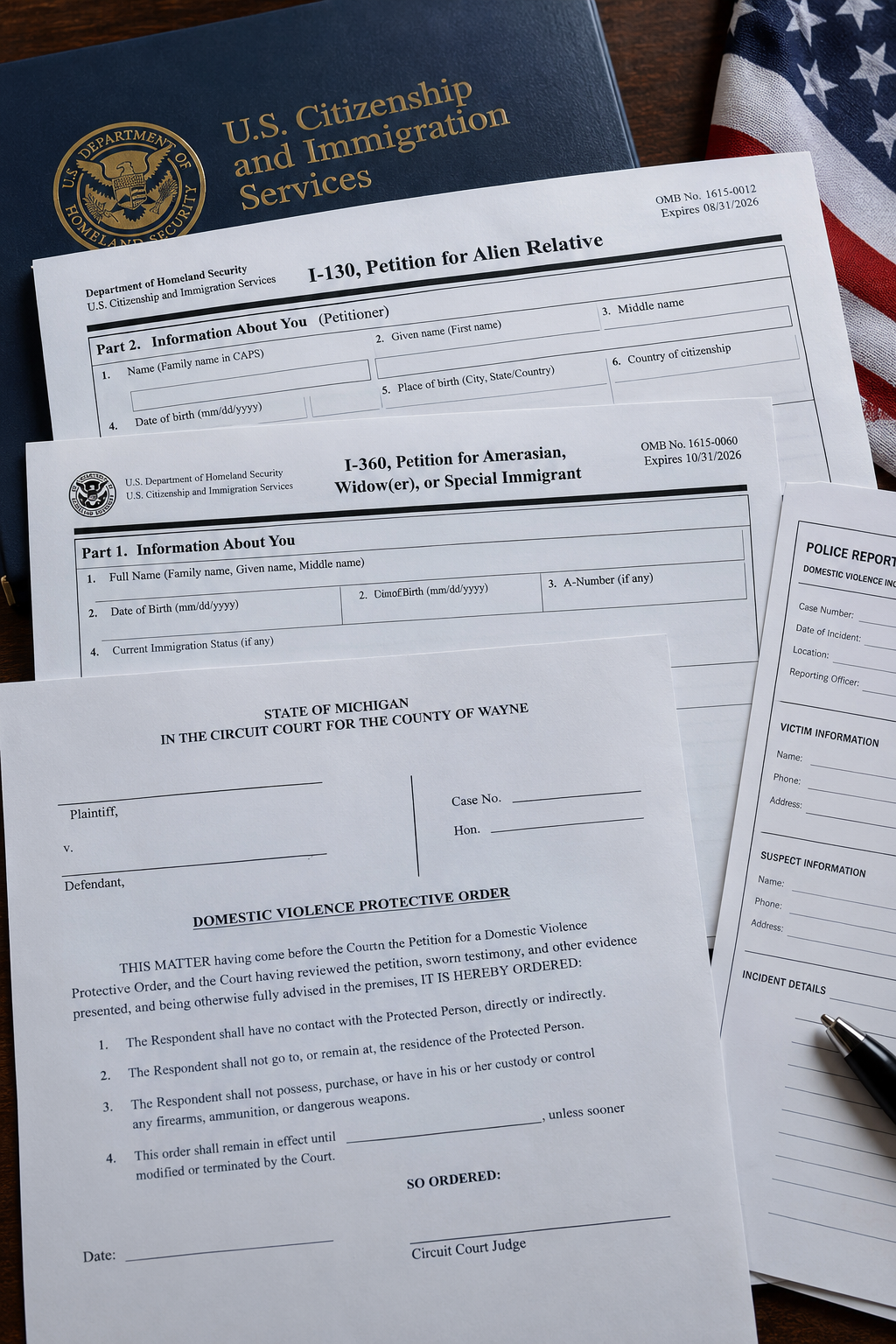
When someone is dealing with marital friction, criminal allegations, and immigration concerns at the same time, the legal landscape becomes complicated very quickly. Many immigrants and lawful permanent residents (green card holders) have urgent questions about how these legal areas intersect and what risks they face.
Below are answers to the most common questions regarding criminal charges, family court disputes, and your legal status in the United States
Can a Domestic Violence Case Affect My Immigration Status?
Yes. Under federal immigration law (specifically INA § 237(a)(2)(E)), domestic violence is an explicit statutory ground for deportation. Even for green card holders, a conviction or formal finding related to domestic assault can trigger removal proceedings in immigration court.
Furthermore, immigration authorities do not look solely at final convictions. When applying for immigration benefits or U.S. citizenship (naturalization), USCIS evaluates your Good Moral Character (GMC). Unfavorable police reports, dismissed domestic violence charges, or patterns of disorderly behavior can still lead to denied applications or heightened scrutiny.
Will ICE Know About My Case?
State and local criminal arrests are routinely reported through shared databases. While not every local misdemeanor immediately triggers active enforcement, federal agencies, including Immigration and Customs Enforcement (ICE), can readily discover open charges or convictions.
If you are a lawful permanent resident, you should always carry valid proof of your legal status, such as your physical green card or an official USCIS receipt notice showing an active renewal. This helps prevent unnecessary administrative holds during interactions with law enforcement.
Can Other Criminal Charges or Traffic Violations Impact My Status?
Yes. Any criminal charge, whether it involves reckless driving, operating while intoxicated (OWI), resisting or obstructing an officer, or petty theft, can jeopardize your immigration status.
Offenses involving alcohol, controlled substances, or allegations of dishonesty are particularly hazardous. Where possible, criminal defense counsel should seek to reduce criminal offenses to civil infractions or immigration-neutral dispositions. This is where close coordination between your criminal defense attorney and an immigration practitioner is indispensable to protect your future.
Should I Be Worried About Attending Court?
Lawful permanent residents attending routine pretrial hearings or misdemeanor dates in state district courts are generally not targeted for detention, but there is never an absolute guarantee.
In certain cases, your attorney may request permission from the judge for you to appear remotely via Zoom or video conference. However, courts possess discretion to deny remote appearances, especially when formal arraignments, trials, or certified foreign-language interpretation require in-person attendance.
Can a Personal Protection Order (PPO) Get Me in Trouble?
Absolutely. Under immigration law, a court finding that you violated a domestic protection order is an independent ground for deportability.
Under Michigan law, violating an active Personal Protection Order (PPO) is punishable as criminal contempt. Even if the protected individual initiates contact with you, you must disengage immediately. The respondent is the only party bound by the order, and responding to their messages can still be charged against you as a violation.
To protect yourself while a PPO is active:
- Work through family court to establish formal, structured parenting time.
- File a motion in circuit court within 14 days of being served to modify or terminate the PPO.
- File for divorce or custody to create enforceable, court-ordered boundaries.
How Do I Safely Retrieve My Belongings From My Home?
If a PPO is in place or domestic allegations have been made, never attempt to retrieve personal items alone.
The safest and most legally sound method is to contact local law enforcement to request a civil standby (police escort). Officers will supervise your entry, ensure you only collect basic necessities, and document the encounter, eliminating the risk of false accusations or PPO violation claims.
Should I Try to Resolve Things Informally With My Ex?
Direct communication, or communication through friends or family members, is extraordinarily risky during active domestic disputes. Informal messages are routinely submitted to courts as evidence of harassment or intimidation.
The safest course of action is to communicate exclusively through legal counsel or court-approved co-parenting platforms (such as OurFamilyWizard).
Should I File for Divorce First?
In Michigan, which party files first does not impact the division of assets under our no-fault divorce laws. However, filing first often provides strategic advantages, including:
- Asking the court for immediate temporary orders concerning child custody, parenting time, and household financial support.
- Establishing an automatic restraining order to freeze marital accounts, prevent dissipation of assets, and halt unilateral insurance cancellations.
- Gaining control over the case timeline rather than reacting defensively.
What About Financial Obligations During Separation?
Until a judge enters a temporary support order, there is technically no statutory obligation to pay child or spousal support. However, voluntarily paying support establishes a practical status quo that judges frequently look to when formalizing support calculations.
In long-term marriages (typically ten years or more), spousal support is frequently awarded alongside formula-based child support. These numbers should be formally calculated by an attorney rather than paid informally.
Can I Take Back Property or Cancel Joint Accounts in My Name?
Unilateral actions, such as canceling vehicle registration plates, cutting off phone lines, or emptying bank accounts, can severely damage your credibility before a family court judge. Once divorce proceedings begin, mutual property-restraining orders generally prohibit altering insurance policies or terminating utilities without mutual agreement or court permission.
Do I Need to Update My Address With Immigration?
Yes, this is mandatory. Under federal immigration law, all noncitizens (including green card holders) must report a change of address using USCIS Form AR-11 within 10 days of moving.
Failing to update your address can result in missed court notices, missed biometrics appointments, or default deportation orders issued in your absence (in absentia). You should also set up mail forwarding with the U.S. Postal Service to ensure you do not miss critical travel documents or renewal notices
Final Considerations
When criminal defense, domestic relations, and federal immigration law intersect, a mistake in one arena can trigger severe consequences in another. Handling these matters proactively with coordinated legal representation is the most effective way to safeguard your freedom, parental rights, and permanent legal status in the United States.
If you or a family member need information regarding an active domestic matter or the assistance of experienced attorneys fighting for people like you every day, call our 24/7 English/Spanish line at (248) 951-2450 or reach out to us at Atiya Law.