
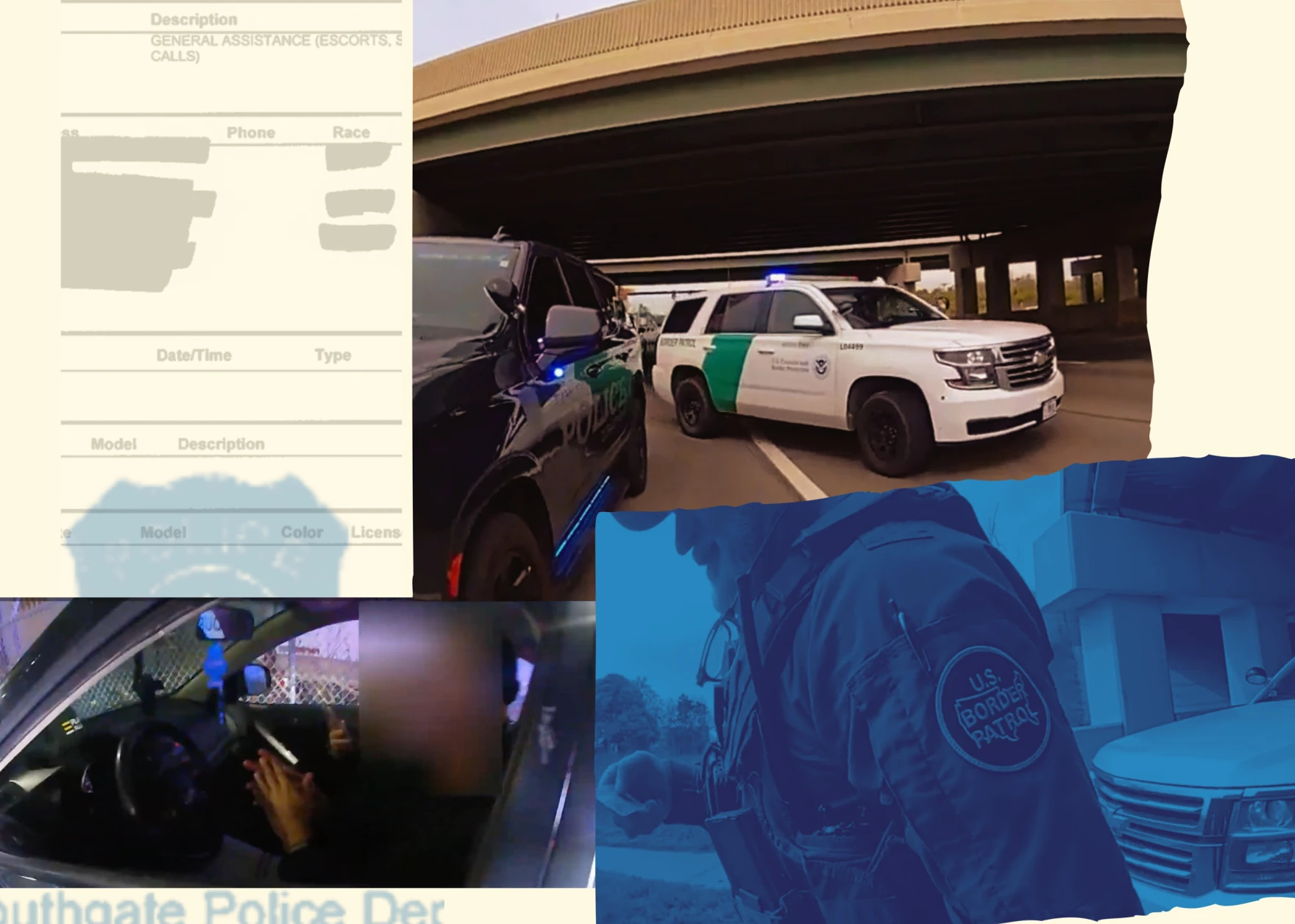
Late on a cool evening in spring 2025, Brownstown Township police officer Matthew Lyles stopped a black SUV as it exited a parking lot.
One headlight was out, he wrote in a police report. But when the driver provided a Colombian license, Lyles called Border Patrol to “validate” it. Federal agents arrested the driver.
Brownstown police didn’t have to turn this minor traffic violation into a federal immigration enforcement operation. Local police generally are not required to assist with immigration enforcement.
Attorneys and some police chiefs argue officers should instead issue a citation or impound the car without involving Border Patrol. Michigan generally recognizes driver’s licenses from foreign countries.
But some police advocates argue that officers need to call federal immigration enforcement to verify identities, check for warrants and ensure road safety.
State policy helped create this dynamic. Since the driver in Brownstown lacked legal status, she wasn’t able to get a Michigan driver’s license. Just a month earlier, in March 2025, state lawmakers shot down a bill that would have expanded driver’s license eligibility for migrants.
Immigrant advocates had spent years making a public safety case for such legislation. They argued that licenses allow migrants to take driving tests and appear in state databases. Without licenses, they warned, routine police interactions could escalate into federal enforcement actions.
Those warnings were well-founded. An investigation by Outlier Media and Michigan Public found that local police reported migrants to Border Patrol at least 388 times since 2021. In most cases, migrants’ lives were upended for minor violations that could have easily resulted in a warning or ticket.

“Usually, my clients get detained because they’re driving and a local police officer will pull them over,” said Shahad Atiya, an immigration attorney in metro Detroit. “Let’s say they run a stop sign. When they cannot produce the driver’s license, usually that’s used as evidence that someone might have a legal status issue.”
More than a dozen states give migrants access to driver’s licenses. Some have also adopted policies designed to separate local policing from federal immigration enforcement.
What the law says
For decades, Michigan politicians have debated whether migrants should be allowed to obtain driver’s licenses.
In 1995, Democratic Attorney General Frank Kelley gave everyone access to licenses as long as they could pass a driving test and prove they lived in the state. Michigan was one of only a handful of states with such a policy.
In 2007, Republican Attorney General Mike Cox issued an opinion that reversed Kelley’s decision, citing implications for state and national security and the potential for fraud.
Lawmakers followed suit with a 2008 law requiring applicants to provide proof of a valid immigration status. Today, a person with a visa can get a driver’s license, but a person who entered the country without authorization cannot, even if they’ve applied for asylum.
Bipartisanship and ‘cowardice’
Some Michigan police chiefs warn that involving local departments in federal immigration enforcement discourages people from reporting crimes. Others — particularly those politically aligned with the Trump administration — view assisting immigration agents as part of their job.
While Michigan lawmakers have left those decisions to municipalities, other states have created guardrails.
Some put direct limits on cooperation between local police and immigration agents. A 2017 Illinois law forbids police from transferring people to U.S. Immigration and Customs Enforcement without a criminal warrant signed by a judge.
When Democrats won full control of Michigan government in 2022, immigration advocates renewed their focus on driver’s licenses.
The coalition backing the reforms called the campaign Drive SAFE, arguing that unlicensed drivers are a danger to everyone on the road.
The bills stalled in the state House along with a long list of Democratic priorities that failed during a dysfunctional session in late 2024.
State Senator Stephanie Chang (D-Detroit) is part of a group of lawmakers who’ve continued to introduce driver’s license legislation during each legislative session. She said Drive SAFE didn’t pass because some Democrats saw it as too “controversial.”
“I don’t know if there’s a way to know exactly how many people have been deported … because of our failure as a state to get this done in 2024,” Chang said.

In 2025, Republicans gained control of the state House. They put the driver’s license bill to a vote as Trump ratcheted up his anti-immigrant campaign. The vote failed 39-64, with six Democrats voting against.
Got tips?
Outlier Media is investigating the role of metro Detroit police departments in federal immigration enforcement. Share your story with reporter Koby Levin via Signal at koby_det.18 or email at koby@outliermedia.org.
Michigan Public is investigating immigration detention and local police collaboration across the state. Reporter Adam Yahya Rayes can be reached at rayesa.24 on Signal or rayesa@umich.edu.
“If this bill passes, Michigan would become a destination state for every illegal alien and prospective illegal alien all over the world,” said state Representative Josh Schriver (R-Oxford).
What’s next?
Chang said the reforms are even more urgent with the second Trump administration’s immigration crackdown.
“Now, [if] you call Border Patrol, there is no question — even if there is no warrant at all, no history of criminal behavior — Border Patrol is coming,” she said. “I think the ramifications of someone not having a driver’s license or state ID now [are] that much greater.”
The sting of Democratic defections during the vote last year hasn’t faded for Danny Celaya, a community organizer who was involved in the Drive SAFE campaign and characterized the “no” votes as “cowardice.”
Still, both Chang and Celaya said they believe Michigan will eventually pass the reforms. Democrats have a chance of retaking the state House next year. Until the bills pass, Celaya said it will be normal for “a grocery trip to lead to a family separation.”
For a single mother, the birth of a child marks the beginning of a lifelong legal relationship between the child and both parents. One of the most critical documents establishing that relationship is the child’s birth certificate. However, many parents do not realize that how parentage is established on that document can have significant consequences for legal custody, decision-making authority, parenting time, and child support.
In Michigan, unmarried parents must pay careful attention to how parentage is legally established and what rights and responsibilities attach when a father is recognized by law.
How Does a Father’s Name Get on the Birth Certificate?
When a child is born to unmarried parents in Michigan, the hospital provides paperwork to establish legal fatherhood. Merely being the biological father does not automatically make someone the legal father in the eyes of the court.
To place an unmarried father’s name on the birth certificate, both parents must sign a form known as an Affidavit of Parentage (AOP). If the father is not present at the hospital or refuses to sign, parentage must be established later, either by completing the affidavit voluntarily or through a legal proceeding.
Establishing legal parentage creates critical legal rights and financial responsibilities for both parents.
The Importance of Legal Parentage and Custody
A birth certificate is far more than a document used for school registration or passport applications. Legally establishing parentage directly affects who holds authority to make major decisions regarding the child.
Legal custody involves decisions concerning:
- Education: School placement and specialized programs.
- Medical Care: Healthcare providers, surgeries, and treatments.
- Religious Upbringing: Places of worship and religious training.
- Relocation & Travel: Moving out of state or applying for a passport.
Under Michigan law, when unmarried parents sign an Affidavit of Parentage, the mother retains initial sole legal and physical custody until a court orders otherwise. However, establishing fatherhood allows the father to petition the court for legal custody or parenting time. This makes early legal planning essential, especially if the father has had little involvement in the child’s life.
Can a Single Mother Get Child Support From the Father?
Yes. One of the most vital principles for single mothers to understand is that child support and parenting time are completely separate legal issues.
A father cannot avoid his child support obligations simply because he does not exercise parenting time or refuses to see the child. Conversely, a mother cannot withhold court-ordered parenting time simply because support payments are late.
In Michigan, child support is calculated using the Michigan Child Support Formula, which takes into account:
- Both parents’ gross incomes.
- The number of overnights/parenting time granted to each parent.
- Healthcare costs and childcare expenses.
- The number of other dependents supported in each household.
A father cannot excuse himself from financial support by stating, “I don’t see the child, so I don’t have to pay.” Child support belongs to the child to ensure their daily financial needs are met.
Michigan child support is generally calculated using a formula that considers factors such as the parents’ income, the number of dependents in the household, the child’s age, and the amount of parenting time or overnights.
What If the Father Refuses to Help?
A mother does not have to rely on the father’s voluntary promises to provide financial assistance.
Once legal parentage is established, a mother can apply for child support services or file a complaint for support in the circuit court. Once a formal court order is entered, payments are monitored and collected through the Friend of the Court (FOC) and the Michigan State Disbursement Unit (MiSDU).
If a parent fails to pay, enforcement measures can include income withholding, tax refund interception, driver’s license suspension, and potential court contempt proceedings.
What If the Father Disputes Paternity?
Paternity disputes can introduce additional legal complexity.
If a man is identified as the father but believes he is not the biological father, formal legal procedures exist to contest parentage. Strict time limits apply when challenging parentage in Michigan courts.
While over-the-counter private DNA kits can offer peace of mind, courts typically require court-ordered, chain-of-custody genetic testing to officially confirm or revoke legal parentage, custody rights, or support obligations.
Why Mothers Should Address Parentage Early
The birth of a child can feel overwhelming, particularly for a single mother navigating the situation alone. However, establishing parentage and resolving support matters early prevents unexpected disputes down the road.
Addressing parentage early provides clarity regarding:
- Securing consistent financial support for your child’s basic needs.
- Defining legal custody and decision-making authority.
- Preventing travel restrictions or passport disputes.
- Ensuring the child access to inheritance, health insurance, and social security benefits.
Final Thoughts
Michigan family law moves quickly, and establishing parentage creates rights and responsibilities that last a lifetime. A single mother raising a child without assistance should never assume she has no recourse.
If you or a family member need information regarding a specific case or the assistance of experienced attorneys fighting for people like you every day, call our 24/7 English/Spanish line at (248) 951-2450 or reach out to us at Atiya Law.