
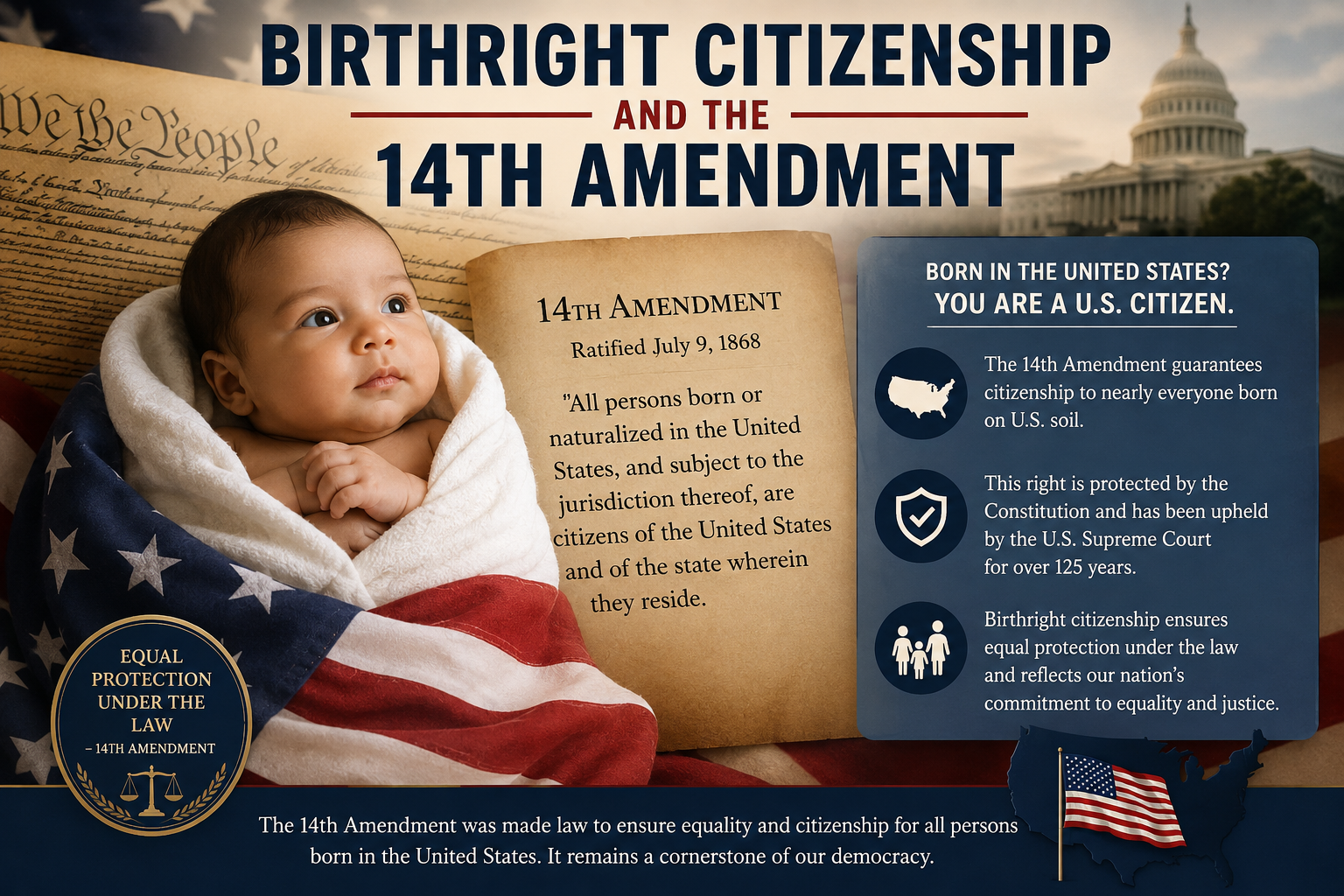
Birthright citizenship has long been one of the defining principles of American constitutional law. In a landmark decision, the United States Supreme Court reaffirmed that principle, rejecting efforts to limit automatic citizenship for children born on U.S. soil by the Trump Administration.
While the ruling represents a significant constitutional victory, it also reignites an important national conversation about immigration, citizenship, and the original purpose of the Fourteenth Amendment.
Understanding why this decision matters requires looking beyond today’s political debate and examining the history that gave rise to one of the Constitution’s most important protections.
The Recent Supreme Court Decision
Recently, President Trump issued an executive order seeking to deny automatic citizenship to certain children born in the United States whose parents were either unlawfully present or temporarily in the country on visas.
The administration argued that these children were not “subject to the jurisdiction” of the United States and therefore were not entitled to citizenship under the Fourteenth Amendment.
The Supreme Court rejected that argument.
The majority concluded that the Citizenship Clause protects children born in the United States regardless of their parents’ immigration status, reaffirming that the Constitution—not an executive order—controls who receives birthright citizenship. The Court also reaffirmed the longstanding interpretation established by United States v. Wong Kim Ark, emphasizing that the Fourteenth Amendment’s text and historical purpose remain controlling.
The decision preserves over a century of constitutional precedent and confirms that changes to birthright citizenship cannot be made simply through executive action.
What Is Birthright Citizenship?
Birthright citizenship is the legal principle that most individuals born within the United States automatically become U.S. citizens at birth. This concept, known by the Latin phrase jus soli (“right of the soil”), has been a cornerstone of American citizenship for more than 150 years.
The legal basis for birthright citizenship comes directly from the Citizenship Clause of the Fourteenth Amendment, which states:
“All persons born or naturalized in the United States, and subject to the jurisdiction thereof, are citizens of the United States and of the State wherein they reside.”
This simple but powerful sentence has shaped American citizenship since 1868 and has repeatedly been upheld by the courts.
The History Behind the Fourteenth Amendment
To understand why the Fourteenth Amendment exists, it’s important to revisit one of the darkest chapters in American history.
In 1857, the Supreme Court issued its infamous decision in Dred Scott v. Sandford, holding that African Americans—even those who were born free—could never become citizens of the United States. The decision denied millions of people basic constitutional rights and helped deepen the divisions that ultimately led to the Civil War.
Following the Union’s victory, Congress sought to ensure that such a ruling could never happen again. During Reconstruction, lawmakers drafted and ratified the Fourteenth Amendment in 1868 to overturn Dred Scott, guarantee citizenship to formerly enslaved individuals, and ensure equal protection under the law.
The Citizenship Clause was intentionally written broadly to prevent future governments from denying citizenship based on race, ancestry, or political preference. Its purpose was to establish a clear constitutional rule: if you are born in the United States and subject to its jurisdiction, you are an American citizen.
The Supreme Court Strengthened Birthright Citizenship More Than a Century Ago
Although the Fourteenth Amendment established birthright citizenship, the issue was tested again in 1898 in the landmark case of United States v. Wong Kim Ark.
Wong Kim Ark was born in San Francisco to Chinese immigrant parents who were legally residing in the United States but were prohibited from becoming naturalized citizens under discriminatory immigration laws. After returning from a trip abroad, he was denied reentry because the government claimed he was not an American citizen.
The Supreme Court disagreed.
The Court ruled that because Wong Kim Ark was born on U.S. soil and was subject to American jurisdiction, he was a U.S. citizen under the Fourteenth Amendment. That decision has served as the controlling interpretation of birthright citizenship for more than 125 years and has become one of the most important constitutional precedents in American history.
Why Birthright Citizenship Matters
Birthright citizenship is about far more than immigration policy. It provides certainty, stability, and equal treatment under the law.
Without a clear constitutional rule, every child born in the United States could face questions about citizenship based on their parents’ legal status, nationality, or immigration history. Such uncertainty would create enormous legal and administrative challenges while undermining one of the Constitution’s core promises of equality.
The Citizenship Clause was designed to prevent exactly that type of discrimination. It ensures that citizenship is determined by constitutional principles rather than shifting political priorities.
The Supreme Court’s recent decision reinforces that constitutional protections cannot be narrowed by executive order and that longstanding constitutional rights remain subject to the rule of law.
Are There Any Exceptions?
Birthright citizenship is broad, but it is not absolute.
There are limited exceptions recognized under constitutional law. For example, children born to accredited foreign diplomats serving in the United States are generally not considered subject to U.S. jurisdiction for purposes of the Fourteenth Amendment. Historically, other narrow exceptions have also existed, but they are rare and well-established.
For the overwhelming majority of individuals born in the United States, birthright citizenship remains the constitutional rule.
Could Birthright Citizenship Still Change?
While the Supreme Court reaffirmed birthright citizenship, the political debate is unlikely to end.
Some lawmakers have suggested passing legislation to narrow eligibility for citizenship. Others argue that because the Fourteenth Amendment’s language is explicit and has been consistently interpreted for generations, any meaningful change would require a constitutional amendment rather than ordinary legislation.
Amending the Constitution is intentionally difficult. It requires approval by two-thirds of both houses of Congress and ratification by three-fourths of the states, making it one of the highest legal hurdles in American government.
As a result, birthright citizenship remains firmly rooted in constitutional law.
Final Thoughts
The Supreme Court’s decision is about more than a single immigration policy. It reaffirms one of the nation’s most fundamental constitutional principles: that citizenship is governed by the Constitution, not by changing political administrations.
If you or a family member need information regarding a specific case or the assistance of experienced attorneys fighting for people like you every day, call our 24-7 English/Spanish line at 248-951-2450 or reach out to us at Atiya Law.