
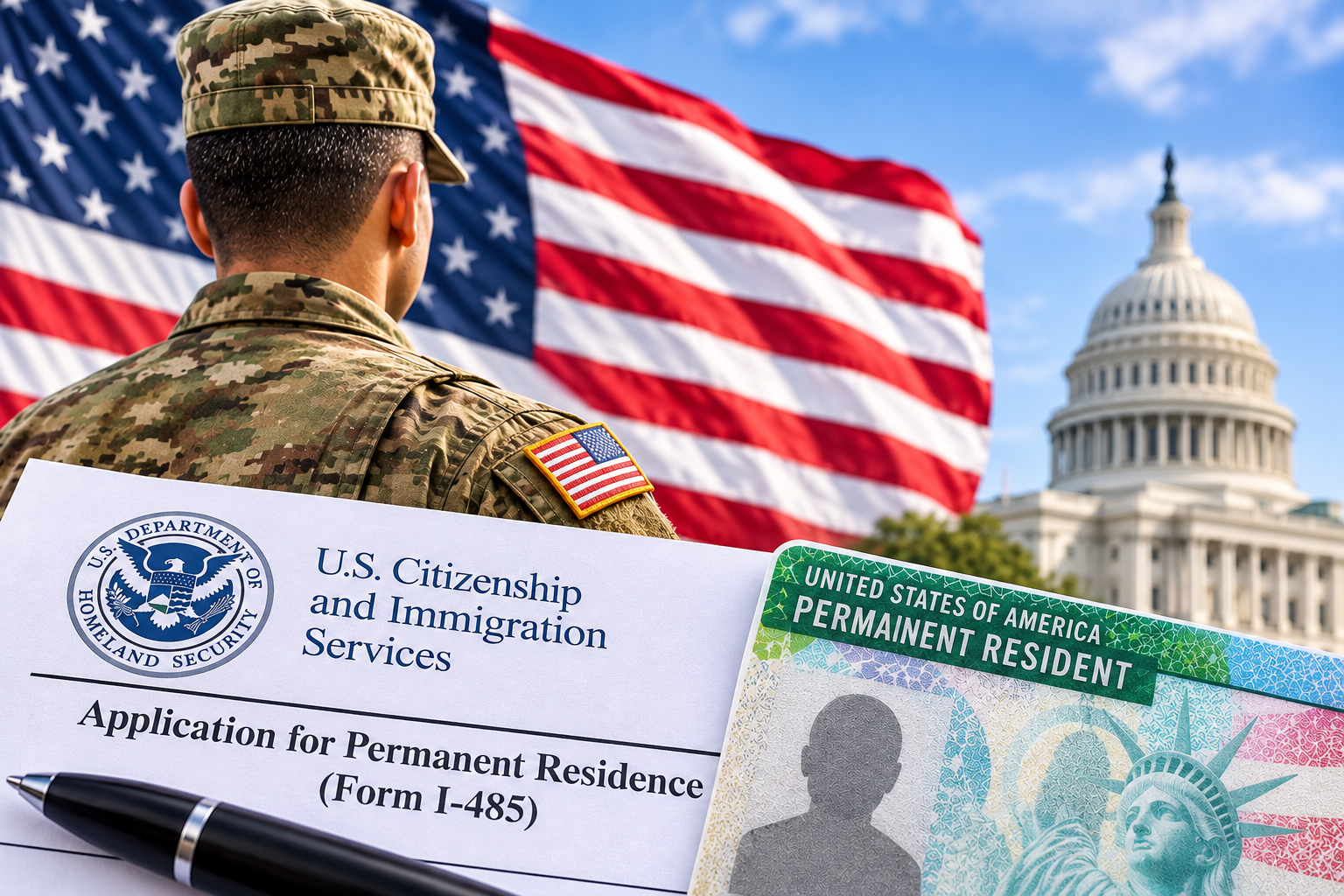
For certain family members of U.S. military service members, veterans, and enlistees, Military Parole in Place (PIP) can provide an important pathway toward obtaining lawful permanent residence in the United States.
Military Parole in Place is a discretionary immigration benefit that may help certain spouses, parents, widows or widowers, and children of U.S. citizens who are serving in the military, veterans, or members of the Selected Reserve. In some circumstances, PIP can resolve a significant immigration obstacle for someone who entered the United States without being formally admitted or paroled.
What Is Military Parole in Place?
Parole in Place (PIP) is a form of discretionary parole granted by U.S. Citizenship and Immigration Services (USCIS) to certain eligible family members of current or former members of the U.S. military.
Normally, a person who entered the United States without inspection or admission does not have a pathway to adjusting status to permanent resident from inside the United States. Military PIP can provide that person with a legal entry for certain immigration purposes, allowing them to pursue adjustment of status without having to leave the United States.
Importantly, receiving PIP does not automatically give someone a green card. It is generally one part of a step that allows an eligible person to apply for permanent residence after 1 year.
Who May Qualify for Military PIP?
Eligibility depends on the applicant’s relationship to the military service member and the individual’s immigration circumstances. Military PIP may be available to certain spouses, parents, children and other family of service members, veterans, or individuals serving in the selected reserve. The military member generally must be a U.S. citizen or lawful permanent resident, depending on the applicable circumstances and current USCIS requirements.
Because PIP is discretionary, meeting the basic relationship requirements does not guarantee approval.
How Can Military PIP Help With a Green Card?
One of the most important potential benefits of Military PIP is that it may address the problem of an entry without inspection.
For example, consider a person who entered the United States without going through immigration inspection. If that person is married to a U.S. citizen who is serving in the military, the person may potentially qualify for Military PIP.
If USCIS grants PIP, the person may then be considered to have been paroled into the United States for certain immigration purposes. If the other requirements for adjustment of status are satisfied, the person may apply for a green card without leaving the United States.
This can be particularly important because leaving the United States after an unlawful entry can create significant immigration consequences, including triggering unlawful-presence bars for many years away from family and loved ones.
What Is the Green Card Process After PIP?
PIP and the green card application are separate steps.
A typical case may involve the following:
1. Establish the Qualifying Military Relationship
The applicant must demonstrate the qualifying relationship to the military service member, veteran, or other eligible individual.
For example, a spouse may provide a marriage certificate and evidence establishing the military member’s qualifying service.
2. Apply for Parole in Place
The applicant submits the appropriate request to USCIS and supporting documentation demonstrating eligibility and explaining why PIP should be granted.
USCIS evaluates PIP requests on a discretionary basis.
3. Receive the PIP Decision
Just because the applicant is in fact related to someone serving in the military does not mean a PIP will automatically be granted. Many times, it simply does come down to the discretion of the officer reviewing the case. If USCIS approves the PIP request, the applicant receives documentation establishing the parole.
PIP approval itself is not a green card and does not automatically provide lawful permanent resident status (but the applicant may qualify for a work permit while their parole is approved).
4. Determine Eligibility for Adjustment of Status
After PIP is granted, the applicant’s immigration history and family relationship must be carefully reviewed to determine whether adjustment of status is available.
For example, an immediate relative of a U.S. citizen may have a different path than a family member of a lawful permanent resident.
5. File the Green Card Application
If eligible, the applicant may pursue adjustment of status by filing Form I-485, Application to Register Permanent Residence or Adjust Status, along with the other required forms and supporting evidence.
Depending on the case, the applicant may also apply for employment authorization and other related benefits.
Does Military PIP Guarantee a Green Card?
Military PIP is discretionary and does not automatically result in permanent residence.
Even after PIP is granted, the applicant must still qualify for adjustment of status or another available immigration benefit. Issues such as prior immigration violations, criminal history, fraud or misrepresentation, prior removal proceedings, previous immigration applications, or other inadmissibility grounds can affect the case.
What Documents Are Usually Needed?
The documentation required will depend on the individual circumstances. A PIP request may include evidence such as:
- Proof of the applicant’s identity
- Proof of the qualifying family relationship
- Marriage certificates or birth certificates, when applicable
- Evidence of the military member’s current or former service
- Military identification or service records
- Evidence of the military member’s U.S. citizenship or immigration status
- Evidence concerning the applicant’s immigration history
- Supporting documentation explaining the request for discretionary parole
Additional documentation may be necessary depending on the applicant’s circumstances.
What If the Applicant Entered the United States Without a Visa?
This is one of the situations where Military PIP may be particularly important.
Generally, someone who entered the United States without inspection cannot simply file an adjustment of status application (or green card) based on marriage to a U.S. citizen. However, Military PIP may provide the required parole element for adjustment of status.
The exact facts matter, including how the person entered the United States, whether they have ever been placed in removal proceedings, whether they have prior immigration applications, and whether any inadmissibility issues exist.
Can Military PIP Help Someone Who Has an Order of Removal?
A prior or current removal case can significantly complicate an immigration case.
Military PIP does not automatically cancel a removal order or eliminate every immigration consequence associated with a prior removal proceeding.
Anyone with a previous removal order, deportation, voluntary departure, expedited removal, or other significant immigration history should have the case reviewed carefully before filing an application.
Can PIP Help With Unlawful Presence?
Military PIP can sometimes provide a way for an eligible person to pursue adjustment of status from inside the United States rather than leaving the country. However, PIP should not be viewed as a general waiver of unlawful presence or other grounds of inadmissibility. The effect of PIP depends on the applicant’s specific immigration history and the benefit being sought.
Why Is Legal Guidance Important?
Military PIP cases can involve multiple areas of immigration law at the same time. A person may need to consider:
- Their manner of entry
- Their immigration history
- Their family relationship
- The military member’s service
- Previous immigration applications
- Prior removal proceedings
- Criminal history
- Possible inadmissibility issues
- Whether adjustment of status is available
- Whether a waiver may be necessary
A mistake in an immigration filing can have serious consequences. An immigration attorney can review the applicant’s history and determine whether Military PIP and adjustment of status may be appropriate. Atiya Law has been successful in preparing Military PIP applications. Every Military PIP and subsequent green card filed by Atiya Law has been approved.
If you or a family member need information regarding a specific case or the assistance of experienced attorneys fighting for people like you every day, call our 24-7 English/Spanish line at 248-951-2450 or reach out to us at Atiya Law.